"Rob Griffith’s third book is a tour de force of metrical mastery but, even more so, a moving exploration of the love, faith, and grief that lie at what Yeats called 'the deep heart’s core.' From a moving two-part sequence on the doubts and triumphs of Saint Columba in the British isles of the early Christian era, to quietly powerful poems that explore the losses and rewards of domestic life, Griffith writes with enviable wit, intelligence, and sensitivity. His love poems are unsurpassed in their aching tenderness, their keen awareness of time’s surrounding presence: 'as the world/goes dark, a stage that fades to black, we glow.' Readers caught in the glow of these stunning poems will discover a pilgrimage made poignant by doubt and faith—where even the cries of birds are 'psalms/that knit your world to mine, the unseen and the seen.' Yet it is the seen world that emerges most vividly here, alive in the 'raptured light' of Griffith’s superb command of craft and unflinching vision."
—Ned Balbo
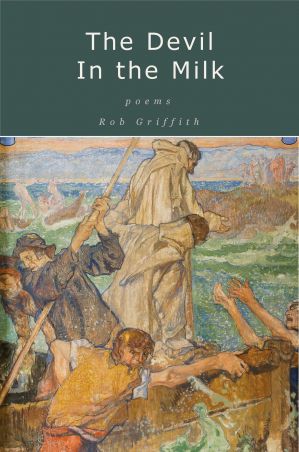
"In Rob Griffith’s The Devil of the Milk, he gives us the fishing trips and porchlit lawns of suburban America in conversation with that great Irish fisher of souls, Saint Columcille of Iona. Columcille gave up his claims as a clan prince to take orders as a monk, founding dozens of monasteries, and went into exile on the deserted isle of Iona, from which he and his followers did outreach to convert the Picts and others to Christianity. He was also a poet. Griffith’s poems channel Yeats and Robert Lowell, with wonderfully wrought forms gem-set with assonance and consonance: 'The aster,/ thrift, and campion spread across the wrack/in lambent scarves of purple, pink, and white.' This is an Ireland of the past brought powerfully back to life, down to the details of fish and fowl and flora and fauna: 'But God is in the corncrake and rock dove,/the kittiwake and goldeneye, the moorhen/and tystie.' And it is an America in search of its spiritual center and seeking to store its angst away in Tupperware and Ziploc bags in the cold white coffin of the fridge and hoping “To learn that death is not the only answer.” This extended sequence about Griffith’s spiritual quest and doubt is dramatic and sorrowful and uplifting, but it is also several things beyond: Beautiful, full of heart, intimately crafted and yet simple and direct, poetry of the highest order."
—Tony Barnstone
"The title sold me. So unexpectedly lyrical. So oddly familiar. The Devil in the Milk lives up to its name. These poems artfully explore the evangelical and the everyday, finding the devil deep in an aching joint, fixating on a winter sky’s salvation and brimstone, fishing in an Ozark stream where a choir of mockingbirds say 'joy.' But it’s not only about belief and religion, or lost hope and optimism for something better than this world. The book lives in our presence, however fleeting, in between. While the speaker in 'A Burden of Light' tells himself to 'step lightly, lightly,' he, like every poem in this collection, certainly leaves a mark."
—Erica Dawson
"St. Columba, who figures prominently in these remarkable poems, journeyed from Ireland to save the souls of men, discovering along the way that all prophecy is a death sentence. Griffith, his contemporary heir and assign, ventures from his own house to find and save his own. The adventure may be merely suburban, but 'he can feel / the constant wash of days and nights unlived / against his shores.' The question he raises is a timeless one: 'Should we ask more of life than life?' The answer is found in the necessary negations that are the springs of joy."
—R. S. Gwynn
"Having clearly demonstrated his pre-eminence among contemporary poets with his previous book, The Moon from Every Window, Rob Griffith has now ascended to the most important and gifted voice of our time. The artfully ordered poems comprising The Devil in the Milk bravely confront the darkness residing in the 'deep heart’s core' as time passes and the struggles of faith and doubt grow increasingly urgent to resolve. These resonant poems—including many convincing Saint Columba dramatic monologues that parallel the emotional and spiritual journeys of the collection’s modern speaker—address a maturing generation awakened to spiritual contemplation and unease from the soporific effects of a materially comfortable life in suburbia, which is memorably evoked as the present land of the lotus-eaters, its inhabitants, drugged on manicured lawns and routine lives, unaware of the need to press onward to a truer home, the discovery of the redemptive light of imagination and pure love, suggested by the opening lines of 'Green Heaven': 'The heart in its bone-house dreams of love / and time'. The Devil in the Milk is vital in its subtle admonition to engage fully in our brief physical existence."
—Samuel Maio